


The Living in Evolution Forum, co-organised by Simed and Grupo Iberinmo (through Observatorio Inmobiliario), explored the transformation of the residential market from a strategic perspective, examining how customer needs, property products and ways of living are changing. It also considered the role of capital, investment and commercialisation in driving new residential developments, with a particular focus on innovative market models along the Costa del Sol.
The forum opened with a panel entitled The new residential market: how customers, products and ways of living are evolving, which examined changing demand, how homes are adapting to it and the potential of new living formats. Participants included Alejandra Vilariño, Business Development Director at Loiola Promotora; Carlos Rueda, Head of Sales Enablement & Customer Loyalty at property portal Idealista; César Frías, architect and CEO of Morph; and Javier Reguart, Managing Director of Alatus Residential Services. The discussion was moderated by Teresa Montero, Director of Observatorio Inmobiliario.
Carlos Rueda began by outlining the changes taking place in demand, with customers becoming increasingly demanding and better informed. This could lead to more personalised homes, better suited to individual markets and specific customer segments. He also noted, among other points, that the rental market had been held back by regulatory uncertainty. In the Build to Sell segment, Reguart expects homes to offer greater personalisation and more technology. Developers should go further, he argued, and understand the services that form part of each project.
According to César Frías, this is the time to deliver affordable housing. However, he also warned against the risk of producing highly standardised products, likening them to “shoeboxes”, as a result of the temptation to move too quickly. He also anticipated greater market segmentation, arguing that there is no reason why everyone should live in the same type of space. He further predicted that, unless society becomes more mature in its approach to attracting investment into Build to Rent, capital will move towards the flex living or hotel sectors instead. These products will become core investment segments because they offer greater security. Sustainability requirements will also influence construction methods and drive industrialisation.
Alejandra Vilariño highlighted adaptability as a key concept, with homes needing to respond to new ways of living and the needs of a changing workforce. As a developer, Loiola is adapting to the different formats sought by new buyers, adjusting communal areas, terraces and the number of bedrooms. One example is its project in El Rompido, Huelva. This is a substantial development that is being adapted to investors’ requirements. The company is also incorporating sustainability criteria, while its wider group includes a construction company that is investing in industrialised building methods.
New ways of living as a solution
Javier Reguart pointed out that in other countries, such as the UK, Build to Rent is driving the new-build market and large-scale landlords are well established. He is convinced that improving access to housing in Spain must come through the rental market. Regarding senior living, the Alatus representative noted that many of the company's developments, which include amenities and have a population comprising almost 90% older foreign residents, could be considered senior living schemes, even if they are not marketed under that label or fully fit the conventional definition. New living formats are therefore not passing trends, but an extension of the property sector that should be supported by public authorities, as they address needs at different stages of life.
César Frías also highlighted that some projects with the right characteristics will naturally evolve into senior living schemes. Some buyers are already purchasing properties with the intention of passing them on as part of their family wealth. Along similar lines, Carlos Rueda identified interest in investment in student accommodation. He acknowledged that the sector has room to grow, but stressed that it remains a niche market and cannot provide a solution to the housing market as a whole. Loiola is also open to different types of development and residential formats.
Spain is a tourism and residential destination, while the Costa del Sol has well-established locations such as Marbella, where services are highly developed. Javier Reguart therefore acknowledged that most of the customers they need to attract will be international buyers. Since several technology companies established operations in Málaga, digital nomads have also moved to the city, seeking different types of homes. Factors such as airport connectivity are becoming increasingly important.
“These are people who are completely transforming Málaga's market,” Carlos Rueda said. “We have the opportunity to make the Costa del Sol the Florida of southern Europe, yet all we do is put obstacles in the way. There could be significant economic growth. If investors were able to establish themselves with confidence, we could attract not only people from northern Europe, but also from Asia.” He is convinced that any developer would be encouraged to invest if the right conditions were put in place.
In this respect, Vilariño insisted that the planning framework is not keeping pace with the need to deliver housing and that public-private collaboration is essential. “Land and timelines are in the hands of public authorities,” Rueda added, highlighting the excessive tax burden faced by the construction sector.
What capital needs
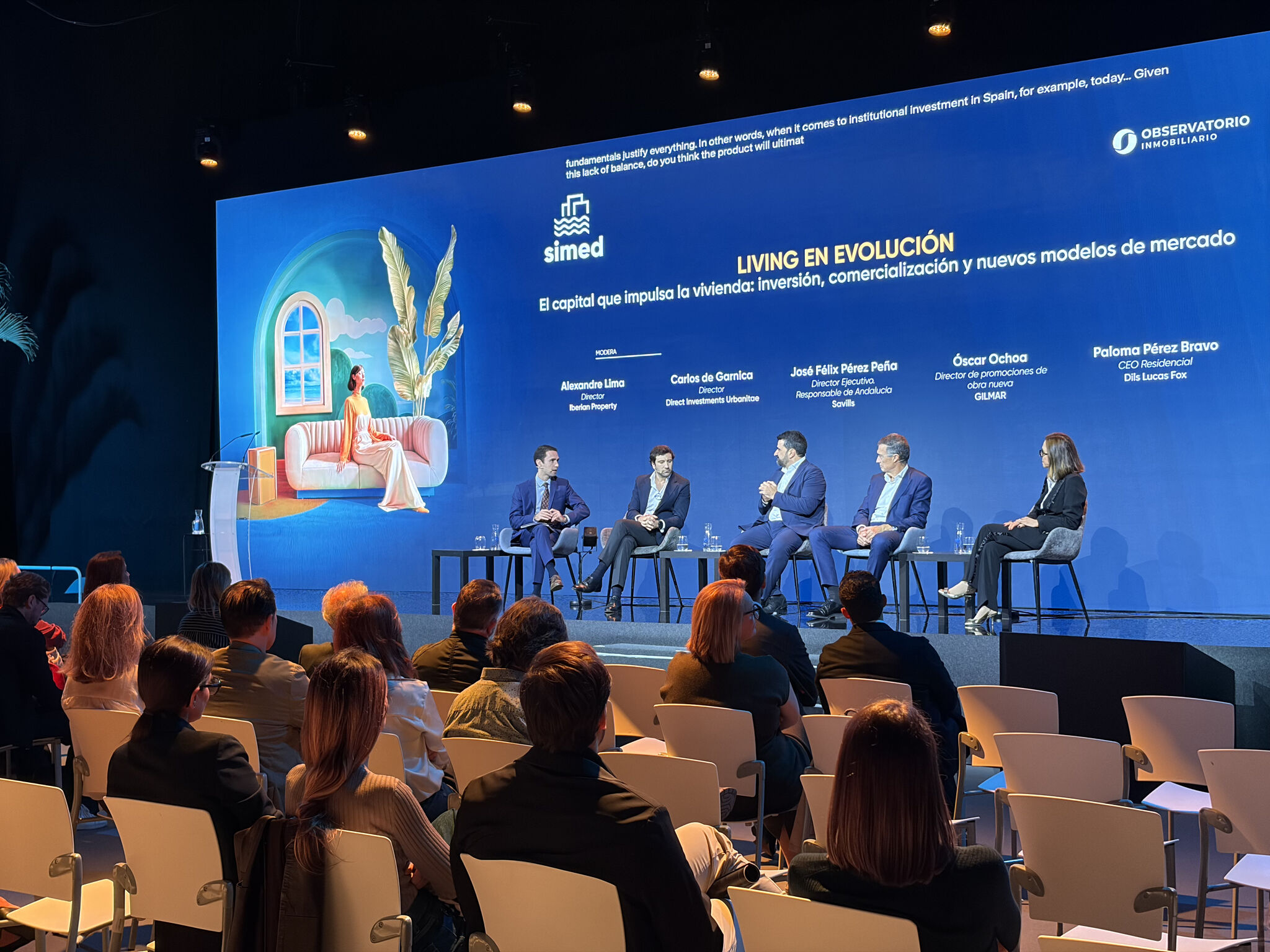
The second panel, entitled The capital driving demand: investment, commercialisation and new market models, also examined what buyers are looking for, particularly in the premium segment, as well as the challenges and opportunities involved in creating new products. Participants were Carlos Garnica, Director of Direct Investments at Urbanitae; José Félix Pérez Peña, Executive Director and Head of Andalucía at Savills; Óscar Ochoa, Director of New-Build Developments at Gilmar; and Paloma Pérez Bravo, CEO Residential at Dils Lucas Fox. The debate was moderated by Alexandre Lima, Director of Iberian Property.
Carlos Garnica stressed that developing projects in locations where demand exists is difficult if it is not possible to deliver them at the price investors require. Planning timelines are neither agile nor predictable. As a result, investors become more aggressive because of the difficulties they encounter along the way.
As one of the principles for addressing this challenge, José Félix Pérez argued that land should not be treated as a speculative asset and must be accessible to bank financing. One figure is particularly relevant: between 200,000 and 300,000 households are expected to be created in Málaga, and their housing needs must be met. The positive side, he noted, is that capital is available for all types of use. However, land needs to move much faster, both in terms of capital deployment and management.
Along similar lines, Óscar Ochoa pointed out that demand for first homes is strong, but affordability remains a problem. As more supply becomes available, this is also creating demand for what he described as a “second primary residence”: a home that may not be the buyer's only or main residence, but which is used beyond holiday periods. The obstacle is that recent political and regulatory developments are likely to drive residential investors away. Addressing this challenge will require measures such as tax incentives through reduced taxation for affordable housing.
The international buyer
Regarding international buyers, Paloma Pérez Bravo highlighted a positive trend: although foreign buyers are completing fewer transactions, the price per square metre has increased. The company's customer base is also becoming increasingly premium. The Dils representative added that the market has not fully understood what premium means: it goes beyond price and is defined by exclusivity. This is a product that is difficult to replicate and attracts highly demanding customers. Luxury buyers often want to purchase free time and good health rather than simply a home, she noted. Sustainability is particularly important in this segment, with the right materials helping to demonstrate a commitment to residents' wellbeing.
She also highlighted the growing diversity of nationalities among foreign buyers interested in purchasing a home. Spain is competing with London, Paris and Milan. The Costa del Sol is home to 150 nationalities, giving it a truly global profile. Pérez Bravo noted that, for buyers from Arab countries, the region is competing with Dubai, while buyers from the Americas and Asia have also discovered its opportunities. This means that a wide range of markets are competing for different types of buyer.
For Gilmar, the foreign buyer typically comes from a middle- or upper-middle-income background. Purchases are financed using their own resources, making these transactions particularly solid from a financial standpoint. “We can add significant value for developers by considering the type of product that can be built, taking architectural constraints into account and analysing pricing according to the target customer,” Óscar Ochoa added. “We have a great deal of data and constantly monitor the market, observing how its direction is changing.” This makes it possible to take strategic decisions on how to adjust a project.
Similarly, Dils' customers are becoming increasingly financially sophisticated. “It is a purchase that combines luxury, pleasure and investment. It has to fit the customer's lifestyle, but it also needs to be profitable, since buyers are generally deploying capital,” Paloma Pérez Bravo explained. Buyers are less concerned with the entry price than with the exit price. They want to know whether they will be able to sell the asset and turn it into cash. There is also a mixed profile of buyers who own three or four homes, perhaps using each one at different times of the year.
New investment criteria
In this context, investors are looking for vehicles that cover every aspect of the transaction, while the range of property types they are considering is also becoming more diverse, Garnica noted. This is partly because of excess demand in the residential market, which is leading investors to seek other products offering higher returns, including logistics, retail units and flex living.
This is essential because growth requires capital to bring projects forward. Málaga has room to expand across its metropolitan area, which is attracting investor interest, particularly given the prospect of new affordable housing, the Savills representative explained. He also noted that capital will become increasingly selective when assessing projects.
Garnica identified a widening range of investment criteria, extending beyond location. What makes the difference is not any single factor, but the overall proposition. Each opportunity needs to be analysed individually to identify the investor for whom it is the right fit.
Meeting investor demand requires new products to be brought to market. Savills therefore called for land to be treated as a strategic resource needed to address an emergency: the shortage of housing. This could become even more acute as population growth is expected to be substantial and Spain could soon become the world's most visited country. All of this means that timelines must be shortened, financing improved and industrialisation encouraged, as it can also help reduce costs.
Furthermore, according to Óscar Ochoa, Spain cannot build 800,000 homes because the country does not have the production capacity to do so, partly due to a shortage of workers. Addressing this challenge will require industrialised construction systems, which are not yet fully developed. Efforts should also be made to encourage refurbishment and decentralisation, as people tend to want to live in the same locations.
Ultimately, however, the most important issue is for the country to build trust and certainty, Paloma Pérez Bravo stressed. Neither lengthy timelines nor instability provide the guarantees investors need. Professionalisation is also essential. Any form of collaboration between stakeholders that helps build confidence, including cooperation with the private sector, should be welcomed. Regarding decentralisation, customers are increasingly accustomed to working and living anywhere, but this needs to be supported by connectivity and infrastructure. This could help create new premium locations, she concluded.

