

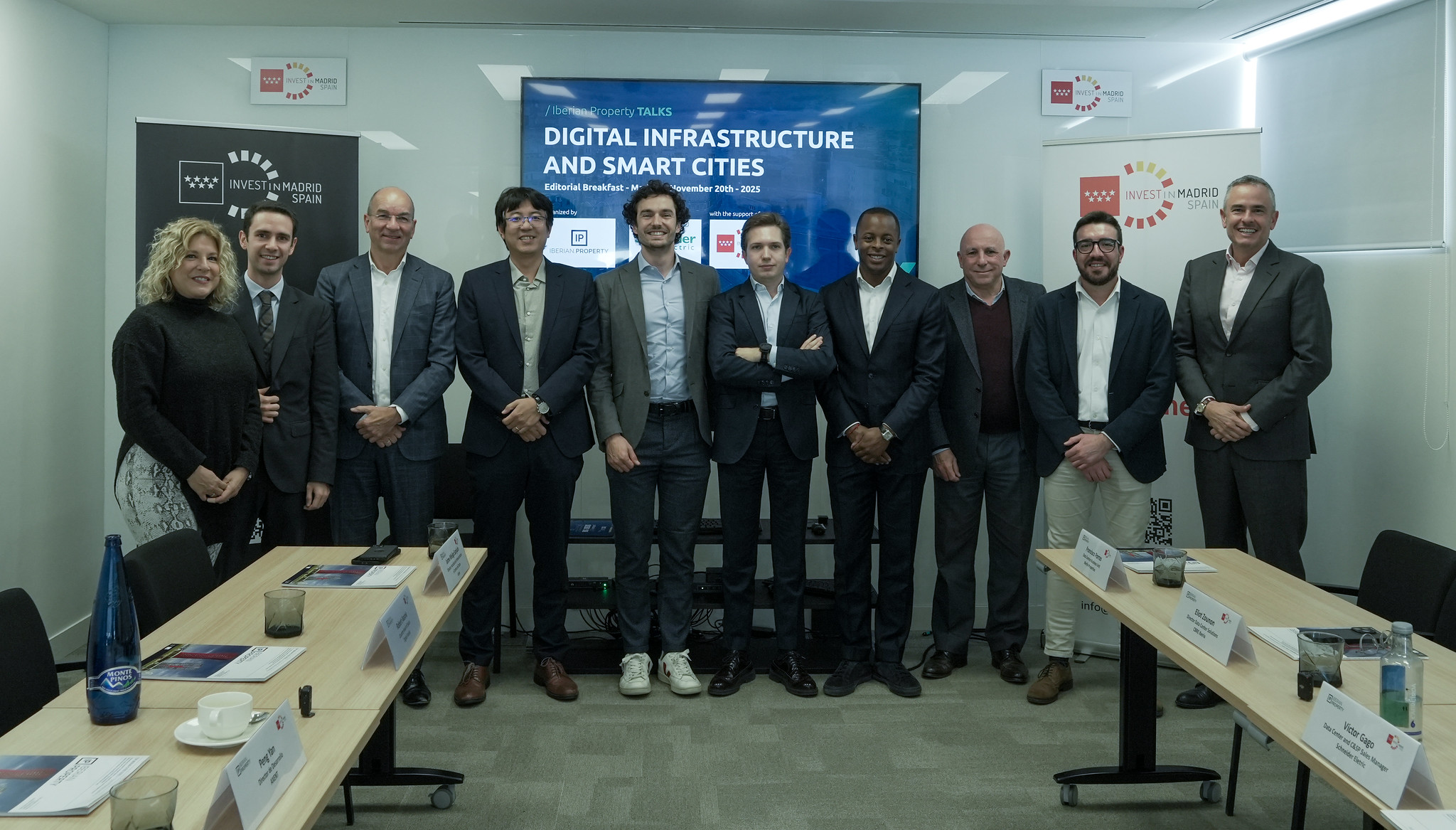
On the 20th of November, Iberian Property convened an Editorial Breakfast under the theme Digital Infrastructure and Smart Cities, hosted at the offices of Invest in Madrid — with the support of Schneider Electric. The session brought together investors, operators, policymakers and infrastructure specialists to explore Madrid’s emergence as a Southern European digital hub, and the opportunities and bottlenecks shaping the next wave of growth.
Jaime Mielgo Sanjuán, Associate Director of Infrastructure and Data Centres at Azora, began by underlining the type of investor Azora is. Often labelled as a real estate investor, in reality the company is an investor in real assets. “Over the past decade, for example, we have developed two gigawatts of traditional renewables, and we had such conviction in the energy transition that we deployed our own balance sheet, not institutional capital”. That experience is what has enabled Azora to move into data centres.
Starting from that foundation, Azora chose to strengthen itself mainly on technical expertise, building a knowledge base organically and inorganically. Regarding the strategy, flexibility was (and is) a key mitigant against obsolescence.
“The pace of change in this sector is extraordinary — I don’t think there is any other real asset with a comparable rate of technological evolution. We build for today’s requirements, but always with a long-term mindset. Nobody has a crystal ball, but you must design based on the trends you see coming”.
This means imagining and anticipating tomorrow’s needs: structural load capacity, for example, becomes critical as equipment becomes heavier and more power-dense per square metre. The same applies to space between floors, to accommodate liquid cooling today — but with the capacity to handle much higher future flow rates should we move towards gigawatt-scale campuses, the expert reasoned.
On the reputational side — Jaime Sanjuán believes the industry has been too slow in shaping the narrative. Critics have been quicker in framing data centres negatively: as low-employment, high-consumption, unsustainable assets. “It is ironic that this is the only industry judged by what it consumes, not by what it creates. When a car plant is announced, nobody calculates how many tonnes of aluminium it will use or how much CO₂ it will emit — we hear about investment, jobs and growth”.
We must communicate the positive impact: economic activity, productivity, innovation, indirect employment and clustering effects. “And we need to articulate a clear message: if we fail to attract this industry, it will develop elsewhere and we will still consume its services — only the economic value will be generated abroad”.
Spain has a unique window: abundant renewable energy, strong fibre penetration and access to subsea cables. It must seize it with ambition.
"Data Centers investors do not wish to be energy specialists, they have been forced into that role"
Jaime Mielgo Sanjuán, provided a last straightforward solution to Spain’s structural energy challenge. "Storage is what allows a system to integrate a far greater share of renewable generation, and countries such as the UK or Germany are already far ahead in regulatory frameworks that support it". The problem in Spain is the absence of a remuneration model for batteries. These assets have two income streams: one derived from intraday price volatility, and another from capacity payments, which compensate batteries for the system services they provide — smoothing intraday price differentials and reinforcing grid stability. Until Spain develops a regulatory and remuneration framework for storage, it will be unable to absorb a higher volume of renewable energy.
Today, the country has around 140 GW of installed capacity and a further 140 GW of renewable projects with access and connection rights. "Yet almost none of this pipeline will be built, except wind, because daytime negative pricing renders most projects unviable. Storage therefore becomes essential. Beyond batteries, however, a second bottleneck remains: transmission infrastructure. The regulatory framework governing grid expansion is outdated and lacks the flexibility the industry now requires". Local permitting for substations and transmission assets can take years, which means that without modernised rules and accelerated approvals, the system will be unable to deliver the energy the market demands.
You can read the full report on this Editorial Breakfast: HERE